


STB 34 – Instrumental Analysis Laboratory
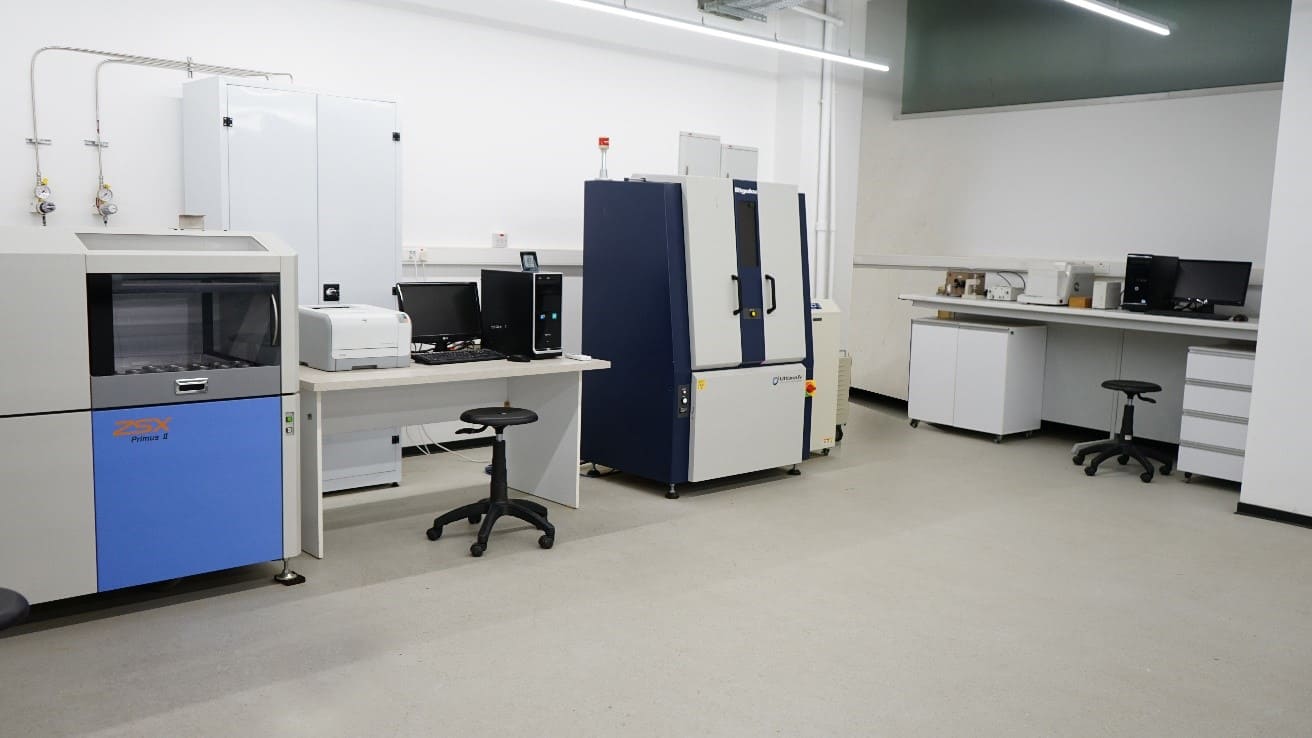
Nowadays, we depend on instrumental analysis techniques in various fields particularly in the pharmaceutical and food industries, with health issues, and for environmental pollution analysis. The Instrumental Analysis Laboratory hosts various devices to characterize various compounds. An X-ray Fluorescence Spectrometer analyzes the elemental composition of the samples from Beryllium to Uranium and can provide semi-quantitative measurement; X-ray diffraction is used for the identification of crystalline structure in solid samples; The Scanning Electron Microscope technique is based on the bombardment of electrons onto the surface of materials to magnify samples up to 300.000 times to provide characteristics images and semi-quantitative measurement; A Particle Size Analyzer is used for the determination of size distribution of the particles in solid and liquid mixtures between the range of 0.02 – 2000µm and a Differential Scanning Calorimeter is used to determine the characteristic heat amount of various samples.
It is a laboratory equipped with advanced analytical instruments such as XRF, XRD, SEM, PSA, zeta sizer, and DSC, where Master’s and PhD-level analyses are carried out. While some of the instruments require maintenance, the laboratory offers a broad range of analyses—from elemental characterization and crystalline structure identification to particle size distribution, zeta potential, and thermal property determination.
The experiments conducted in this laboratory are as follows:
- XRF is used for elemental composition of solid samples (the instrument requires maintenance)
- XRD is used to determine crystalline structure of samples
- SEM is used to magnify samples x 200.000 (Requires maintenance)
- PSA is used to determine particle size distribution of the mixtures (Requires laser lam replacement)
- Zeta sizer (Requires maintenance)
- DSC is used to determine boiling and freezing point of the samples.
