
STB 30 – Chromatography Laboratory
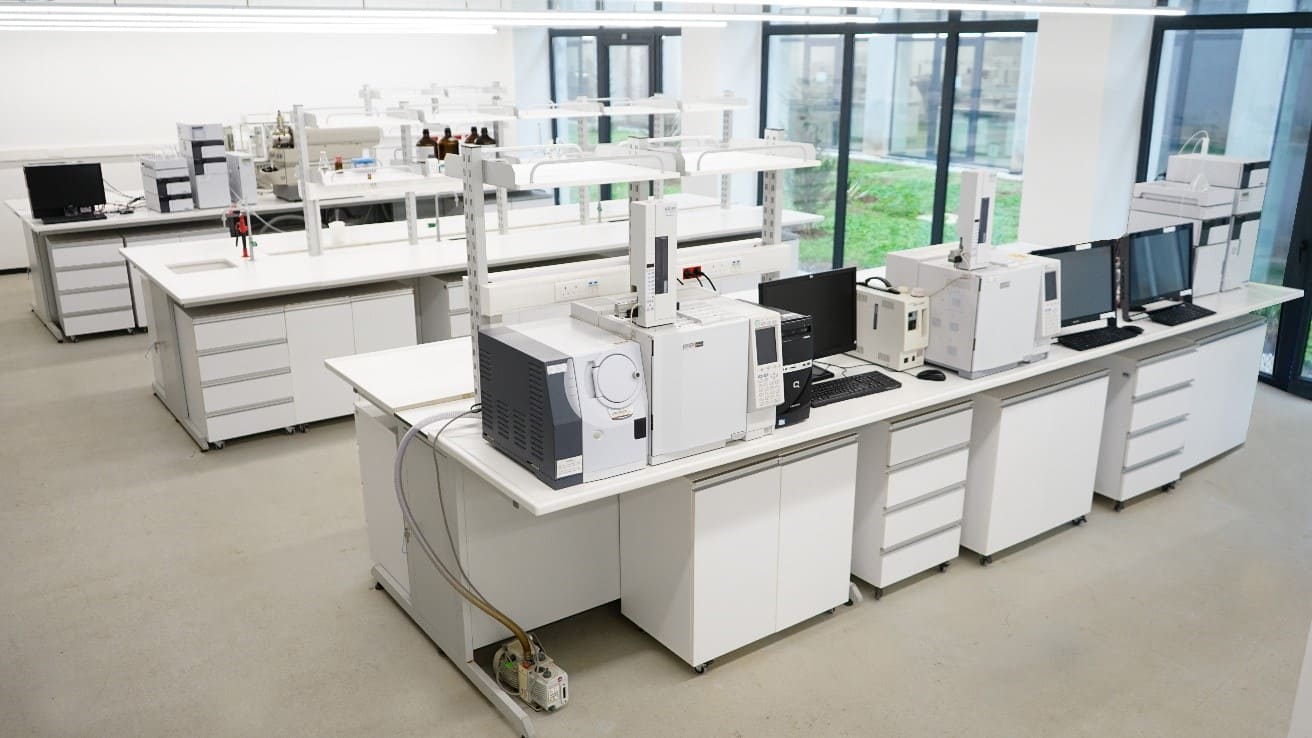
Chromatography is a widely used method for the separation, identification, and determination of chemical components in various mixtures. The Chromatography laboratory contains three major chromatographic instruments: Ion Chromatography (coupled with a Conductivity Detector) to determine major cations (Sodium Na+, Potassium K+, Calcium Ca2+, and Magnesium Mg2+) and anions (Chloride Cl-, Nitrate NO3-, Sulfate SO42-); Gas Chromatography (coupled with a Mass Spectrometer, an Electron Capture Detector, and a Flame Ionization Detector) to determine volatile organic molecules and gaseous compounds, and Liquid Chromatography (coupled with an Ultraviolet and Refractive Index Detector) to determine polar/nonpolar nonvolatile organic molecules in various matrices. This laboratory also has a Total Organic Carbon Analyzer, which is used to estimate the organic load of various mixtures.
The experiments conducted in this laboratory are as follows:
- Solution preparation practices
- Reaction kinetic practices using UV-vis spectrophotometer
- Turbidity measurement in water by nephelometer
- Color measurement in water by UV-vis spectrophotometer
- pH measurement in water by pH meter
- Solids measurement in water by various general equipments
- Chloride measurement in water by titration set-up
- Alkalinity measurement in water by titration set-u
- Acidity measurement in water by titration set-up
- Hardness measurement in water by titration set-up
- Dissolved oxygen measurement in water by titration set-up
- BOD test with dissolved oxygen measurement and incubator
- COD measurement in water by HACH LANGE spectrometer
- Nitrate measurement by HACH LANGE spectrometer
