

STB 16 – Digital Communication Laboratory
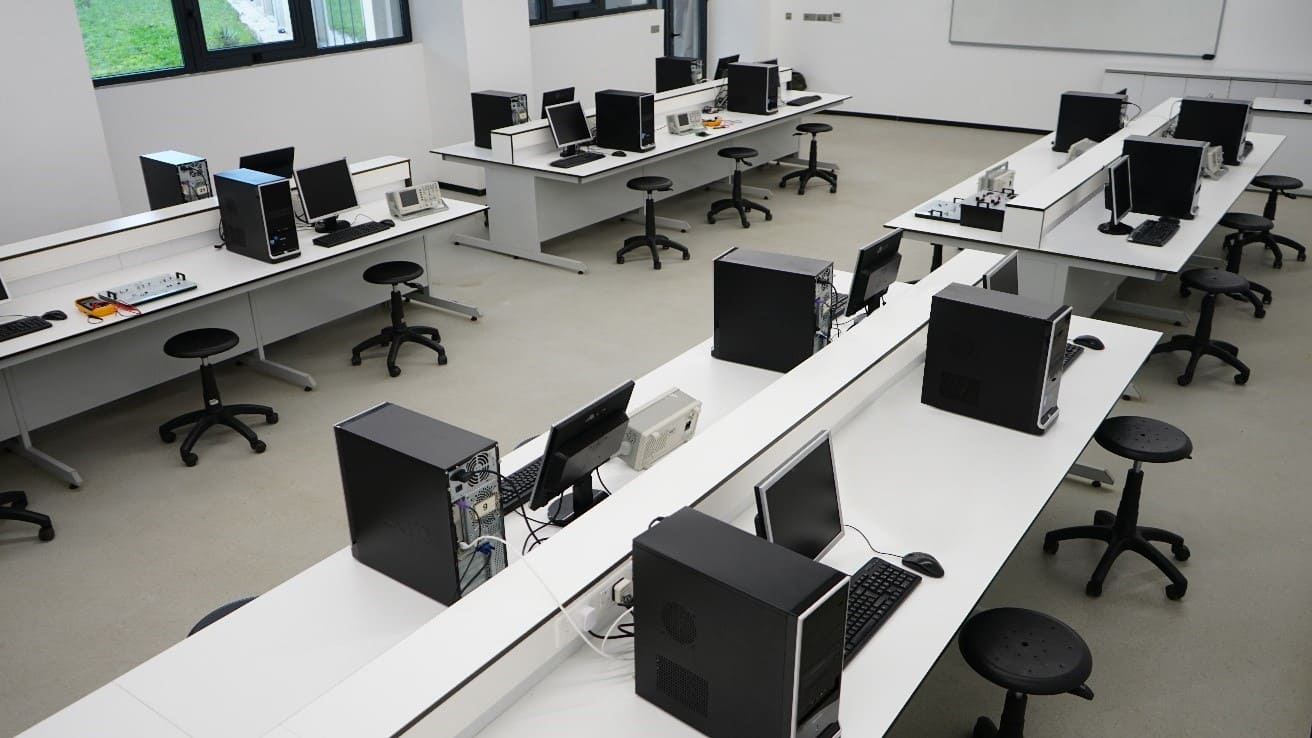
The communication training set in the Digital and Communication Systems laboratory consists of a main unit and thirteen application modules, designed to enable applications related to analog and digital communication. The working areas consist of modulation techniques, coding, and decoding techniques. Applications of the modulations consist of AM, SSB, FM, PM, PAM, PCM, PFM, PPM, DM, ASK, FSK, and PSK in the analog and digital sections. In the demodulation set and digital part, AM, SSB, FM, PM, PAM, PCM, PFM, PPM, DM, ASK, FSK, and PSK demodulation applications can be done.
Also, students can apply the digital systems by using the digital electronic training sets in the laboratory. Among the digital electronics experiments, TTL logic gates applications, CMOS logic gates applications, NAND, NOR and XOR logic gates applications, digital adders-subtractors applications, decoders/demultiplexers and multiplexers applications, d-type & jk-type flip-flops applications, binary counter, ADC applications, and DAC applications take place.
The experiments conducted in this laboratory are as follows:
1. Introduction to Simple 2-level Logic Circuits in hardware lab
2. Introducing xor and xnor in 2-level logic circuit in Hardware lab
3. Design 2-level logic circuit in Hardware lab
4. Design 2-level Nand-NOR logic circuit in Hardware lab
5. Software Implementation of 2-level XOR and XNOR
6. Hardware Implementation of 2-level Logic Circuits
7. Software Implementation of Full-Adder Circuit
8. Software Implementation of Half-Adder / Half-Subtractor Circuit
9. Hardware Implementation of Multiplexers
10. Software Implementation of Decoders
11. Hardware Implementation of Synchronous Sequential Circuit
12. Waveforms (Sinusoid, Square and Triangular). Signal generation, display and measurement.
13. AM modulation & Demodulation
14. A/D and D/A Conversion
15. Time Division Multiplexing
16. Analysing the Hartley Oscillator
17. Analysing the Colpits and the Crystal Oscillators
18. Analysing the Low-pass Filters
19. Analysing the High-pass and Band-pass Filters
20. Designing a Band-Pass Filter
21. Analysing an Analog to Digital Converter
22. Analysing the Amplitude Modulation (AM) and the Demodulation
23. Analysing the Frequency Modulation (FM) and the Demodulation
