
EL 102 – Hydraulic / Drilling Fluids Laboratory
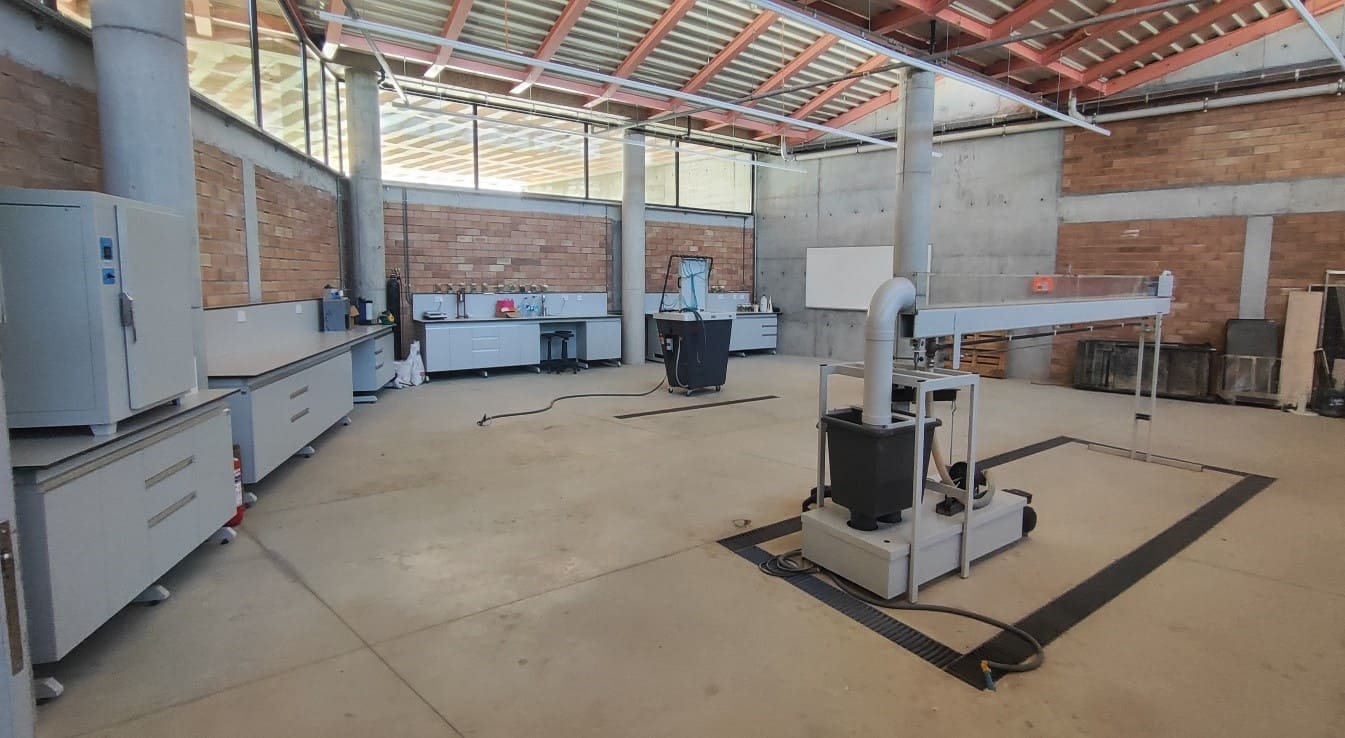
The Hydraulics Laboratory is a facility used to conduct a variety of experiments pertaining to water. The Hydraulics Laboratory consists of two physical modeling facilities:
1. A 5-m long Flow Channel and
2. A Volumetric Hydraulic Bench. With the available facilities, experiments related to pipe flows and open channels can be covered.
The main objectives of the Hydraulics Laboratory are to provide the student with an opportunity to:
a) explore the fundamental principles of fluid mechanics through experimentation and
b) demonstrate and analyze key hydraulic phenomena using hands-on physical devices.
Drilling fluids laboratory serves to Petroleum engineering department undergraduate and graduate students to conduct relevant tests on drilling fluids. In this laboratory, students are able to characterize the drilling fluids (drilling mud) by using vapor pressure testing equipment, analytical balance, magnetic stirrer, Marsh funnel, sand equivalence test set, filter pres, and sand content test set. In the drilling fluids laboratory, determination of filtration and cake formation characteristics, the volumetric content of the particles having a greater size than sand (74 microns) in drilling fluids mixture, and fluid properties of the drilling mud during its flow through a standard cone. Drilling fluid is a mixture of water, organic, and gas fluids containing several additives. In this laboratory, designing and characterizing of the mixture is accomplished by several equipments.
Research Opportunities
- Preparation of mud programs for drilling wells.
- Designation of several solutions for the problems encountered in drilling areas.
- Conducting research on new trends in drilling technologies and their applications.
- Investigation of the efficiency of drilling mud and filtration.
The experiments conducted in this laboratory are as follows:
- Pipe work energy losses.
- Broad Crested Weir.
- Manning Coefficient.
- Discharge calc. using open channel flow.
